
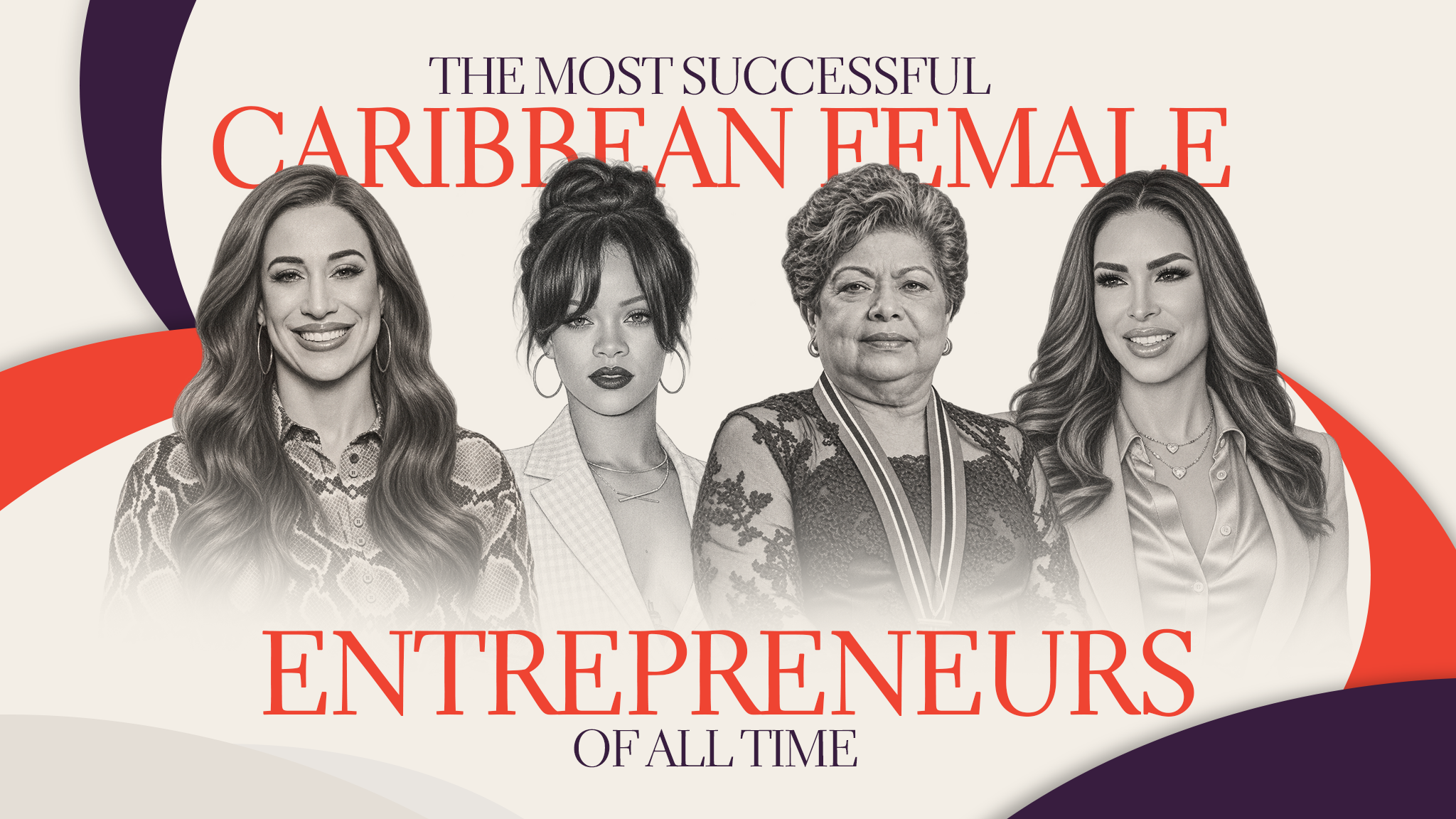
Across three centuries, Caribbean women have founded global consumer brands, established financial institutions, built industrial businesses and accumulated fortunes whose influence extended far beyond the region.
STATURE’s inaugural historical assessment examines 20 women whose entrepreneurial achievements helped shape markets, establish commercial institutions and create economic value across generations.
The Caribbean has produced entrepreneurs whose businesses have reached consumers, investors and industries around the world.
Their achievements span beauty, finance, manufacturing, music, hospitality, healthcare, retail and international commerce. Some built internationally recognized brands. Others developed enterprises that became fixtures of their industries and national economies.
Their careers unfolded across vastly different periods.
In eighteenth-century Suriname, Elisabeth Samson accumulated one of the colony’s largest private fortunes through commerce, property and plantations sustained by enslaved labor. More than two centuries later, Jamaican-born Trisha Bailey developed an American business portfolio with reported annual revenue in the hundreds of millions of dollars.
Rita Humphries-Lewin established Jamaica’s Barita Investments in 1977, developing a financial institution that would become the subject of a multibillion-dollar Jamaican acquisition.
At the top of the index, Barbados-born Rihanna helped create Fenty Beauty, which generated approximately US$450 million in net sales in 2024, according to Reuters.
These women built businesses, developed markets, accumulated commercial assets and exercised ownership in enterprises operating across the Caribbean and beyond.
Their achievements form part of a wider history of Caribbean enterprise and international economic participation.
For this inaugural historical index, STATURE examined the nature and scale of their entrepreneurship, the value created through their businesses and the durability of their commercial achievements.
The assessment draws on corporate disclosures, transaction reporting, institutional records, business histories and financial journalism.
What did these women build, and how significant were their entrepreneurial achievements?
That question guides the selection and comparative assessment of the 20 entrepreneurs featured in this edition.
The Economics of Ownership
Ownership is central to the creation of entrepreneurial wealth.
The commercial significance of a business depends on its operating scale, economic performance, ownership structure and ability to create lasting value.
An entrepreneur’s stake, contribution to the enterprise and involvement in major commercial decisions provide important context for understanding her achievements.
STATURE evaluates these factors through a six-dimensional framework covering commercial scale, entrepreneurial value creation, agency and ownership, longevity, market expansion and lasting commercial significance.
Commercial scale and entrepreneurial value creation account for 60 of the 100 available points.
The framework brings together entrepreneurs whose businesses developed through different ownership structures and commercial models.
Rita Humphries-Lewin founded Barita Investments in 1977. In 2018, Cornerstone Investments offered just over J$3 billion for a majority interest in the company, with Humphries-Lewin among the shareholders identified in the transaction.
Audrey Marks built Paymaster Jamaica into a nationwide payment-services network. She sold a majority interest before reacquiring Digicel’s 80% stake in its parent company in June 2026.
Helen Bhagwansingh helped develop a diversified Trinidadian business group spanning hardware, steel manufacturing, construction and related industries. A University of the West Indies profile published in 2011 documented approximately 1,200 employees across its operations.
Their ventures developed value through financial services, payment infrastructure, manufacturing, distribution and sustained commercial expansion.
Each demonstrates the economic significance of building and maintaining substantial enterprises.
Caribbean Enterprise on a Global Stage
The international beauty industry provides some of the most prominent examples of Caribbean entrepreneurial achievement.
Rihanna leads the index through the development of Fenty Beauty, an internationally distributed cosmetics company launched in 2017 in partnership with Kendo, the beauty incubator associated with LVMH.
The company entered the market with an extensive foundation shade range and a consumer proposition that attracted international attention.
Fenty Beauty grew into a major global cosmetics business.
Reuters reported in October 2025 that the company generated approximately US$450 million in net sales during 2024. The same report described discussions concerning LVMH's 50% ownership interest and cited a possible enterprise valuation between US$1 billion and US$2 billion.
The valuation reflected the potential value of the entire company in those discussions.
Second-ranked Carolyn Aronson developed It’s a 10 Haircare into a major American beauty enterprise.
Founded in 2006, the company expanded from professional haircare into a widely distributed consumer-products business.
In 2017, Aronson acquired her original business partner’s interest, consolidating full ownership of the company.
Retail Brew reported in May 2026 that the expanded enterprise was generating approximately US$500 million in annual sales.
Aronson’s record reflects the commercial significance of founder ownership, product development and sustained consumer demand.
The two entrepreneurs developed substantial beauty businesses through different financing structures, distribution relationships and approaches to ownership.
Elsewhere in the index, Dany Garcia established businesses spanning entertainment production, management and professional sports. Pat McGrath founded a globally recognized cosmetics company that attracted major institutional investment before undergoing financial restructuring in 2026.
Gisselle Hernandez built Glamlite Cosmetics into a multimillion-dollar enterprise through distinctive product development and direct-to-consumer distribution.
Together, their careers demonstrate the international commercial reach of Caribbean entrepreneurs across consumer industries.
The Businesses That Endured
Several women in this index developed enterprises whose commercial importance is reflected in decades of operation.
Patricia Chin helped establish VP Records as a major international distributor of reggae, dancehall and other Caribbean music.
Thalia Lyn developed Island Grill into one of Jamaica’s most recognizable indigenous quick-service restaurant businesses.
Mirta de Perales created a beauty enterprise whose commercial identity continued across Cuba and the United States.
Lyla Kissoon helped establish a Guyanese business in 1951 that expanded into manufacturing, retail and related commercial activities.
Their companies developed products, employment, supply relationships, customer networks and business infrastructure.
Music distribution connected Caribbean recordings to international markets. Restaurant expansion strengthened domestic supply chains. Manufacturing enterprises developed productive capacity. Financial-services networks broadened access to everyday commercial transactions.
These institutions contributed to the economic development of the markets in which they operated.
Their longevity remains an important part of the entrepreneurial record.
Wealth Within the Colonial Economy
An all-time assessment of Caribbean entrepreneurship also encompasses the region’s colonial commercial history.
Elisabeth Samson and Dorothy Kirwan Thomas accumulated substantial fortunes in societies organized around slavery and racial hierarchy.
Both achieved exceptional commercial standing while also owning enslaved people and benefiting from forced labor.
Samson’s plantations and Thomas’s trading and property interests formed part of colonial economic systems sustained by exploitation.
Their inclusion records their documented economic standing and entrepreneurial activities alongside the circumstances through which portions of their wealth were created.
The history of Caribbean commerce includes extraordinary enterprise, concentrated economic power and systems of profound injustice. These realities remain integral to the historical record.
The Complete Historical Index
The following 20 entrepreneurs comprise STATURE’s inaugural November 2026 historical assessment.
Each receives a STATURE Success Score based on six weighted dimensions of entrepreneurial achievement.
Born in Nickerie, Suriname, Lyla Kissoon helped establish A.H. & L. Kissoon with her husband, Alston Kissoon, in Georgetown, Guyana, in December 1951.
The business began as a dry-goods operation and expanded into furniture manufacturing, retail and related commercial activities.
Following her husband’s death in 1966, Kissoon played a central role in sustaining and developing the enterprise.
Under successive generations, the business became associated with local manufacturing, home furnishings and commercial services.
Its growth and longevity reflect the commercial institution Kissoon helped establish.
She died in July 2025 at the age of 95, leaving a business legacy spanning more than seven decades.
Daisy Fuentes developed a fashion and lifestyle licensing business through a long-standing relationship with American department-store retailer Kohl’s.
Born in Havana, Cuba, Fuentes launched her branded collection in 2004, expanding its presence across clothing and other consumer merchandise categories.
In October 2011, the Los Angeles Times reported that the Daisy Fuentes collection had generated approximately US$800 million in cumulative retail sales.
The figure reflects merchandise sold through retail channels under the Daisy Fuentes brand.
Her commercial achievement includes the development of a recognizable consumer brand, sustained retail distribution and a licensing relationship that endured across multiple product categories.
Born in Haiti, Solanges Vivens established Vital Management Team, Long Term Care, Inc. in 1988, developing an American healthcare-management enterprise.
Her work centered on long-term care and related services, an industry requiring sustained operational management and regulatory compliance.
Vivens consolidated ownership of the business and developed its operations over approximately three decades.
In 2018, she sold the company, completing a commercial exit after decades of entrepreneurship.
Her career encompasses business creation, healthcare operations, ownership consolidation and the development of a durable commercial enterprise.
Mirta de Perales established a beauty enterprise whose commercial history extends across Cuba and the United States.
Beginning her career in Cuba’s beauty industry, she developed a business associated with haircare, cosmetology and products serving Hispanic consumers.
Following the Cuban Revolution, the business was rebuilt in the United States, where the Mirta de Perales name became associated with haircare products distributed through American and Latin consumer markets.
The brand’s endurance reflects Perales’s commercial development, cross-border reinvention and the continued relevance of the enterprise she created.
Her career represents an important chapter in the history of Cuban entrepreneurship and Hispanic consumer brands.
Born in New York to Puerto Rican parents, Jennifer Lopez developed commercial interests in entertainment production and consumer products.
Her ventures include Nuyorican Productions, the film and television company through which she has developed and produced entertainment projects.
In June 2021, Netflix announced a multiyear first-look agreement with Lopez and Nuyorican Productions, co-run with producing partner Elaine Goldsmith-Thomas.
The agreement established a significant international distribution relationship for the company’s production activities.
Lopez also participated in the creation of JLo Beauty through a commercial joint venture.
Her entrepreneurial record encompasses content production, brand development and participation in consumer-products businesses with international reach.
Dominican-born Gisselle Hernandez founded Glamlite Cosmetics in 2017 and developed the business into a recognized cosmetics brand.
Following early commercial challenges, Hernandez reshaped the company’s product strategy around distinctive cosmetics, unconventional packaging and direct consumer engagement.
Glamlite subsequently expanded through e-commerce, product collaborations and an increasingly established consumer audience.
In August 2024, Forbes reported that the company had generated more than US$30 million in cumulative sales.
Hernandez’s achievement reflects direct founder involvement, commercial repositioning and the development of a growing consumer-products enterprise.
Born in Havana, Gloria Estefan developed substantial commercial interests beyond her international recording career.
Together with her husband and business partner, Emilio Estefan, she established interests in hospitality, restaurants, entertainment and commercial property.
Their hospitality portfolio includes the Cardozo Hotel in Miami Beach and Costa d’Este Beach Resort & Spa in Vero Beach, Florida.
The Cardozo underwent extensive renovation before reopening in 2019, demonstrating the couple’s continued investment in the property.
Estefan’s entrepreneurial record includes long-term participation in jointly owned hospitality businesses, operating assets and commercial ventures extending across multiple industries.
Born in Santiago de Cuba, Rita Marley played a central role in developing important commercial institutions within Jamaica’s music industry.
Following Bob Marley’s death in 1981, she acquired the former Federal Records facility in Kingston and developed it into a base for Tuff Gong’s recording, manufacturing and distribution operations.
In 1986, she established the Bob Marley Museum at the family’s former residence in Kingston.
These ventures became enduring components of Jamaica’s music and cultural tourism industries.
Marley’s entrepreneurial achievements include commercial acquisitions, the development of recording infrastructure, museum operations and decades of institutional stewardship.
Her contribution helped strengthen the business infrastructure supporting Jamaica’s international music industry.
Jamaican-born Trisha Bailey built a diversified American business portfolio centered on Bailey’s Pharmacy & Medical Equipment & Supplies.
Her commercial interests subsequently expanded into real estate and additional privately held enterprises.
In March 2025, the University of Connecticut reported that Bailey’s businesses collectively employed more than 500 people and generated annual revenue in the hundreds of millions of US dollars.
The university also described a portfolio encompassing her flagship company and numerous additional ventures.
Bailey’s entrepreneurial career reflects significant business creation, commercial diversification, employment and operating scale across multiple industries.
Her portfolio places her among the most commercially consequential Jamaican-born entrepreneurs operating in the United States.
Thalia Lyn founded Island Grill and developed it into one of Jamaica’s leading indigenous quick-service restaurant enterprises.
The company grew through decades of expansion, establishing a recognizable consumer brand and an operating network across Jamaica.
In August 2025, Island Grill opened its 18th location, according to the Jamaica Observer.
Earlier reporting in the Financial Gleaner placed the company’s annual sales above J$2 billion in 2019.
Lyn’s commercial achievement reflects long-term founder leadership, the development of a national restaurant business and sustained operating activity within Jamaica’s food-service industry.
Born in England to a Jamaican mother, Pat McGrath founded Pat McGrath Labs in 2015, creating an internationally recognized cosmetics brand.
Her commercial enterprise built on an established creative career in the global beauty industry.
In 2018, Eurazeo invested US$60 million in Pat McGrath Labs. Contemporary industry reporting associated the financing with a company valuation exceeding US$1 billion.
The brand expanded internationally, developing an influential position in luxury cosmetics.
In January 2026, Pat McGrath Cosmetics filed for Chapter 11 bankruptcy protection. The company completed a restructuring in April under a new controlling ownership arrangement involving GDA Luma.
McGrath’s historical entrepreneurial achievement includes creating a globally distributed beauty company, attracting substantial institutional investment and developing an influential commercial brand.
The 2026 restructuring forms part of the company’s subsequent ownership and financial history.
Born enslaved in Montserrat, Dorothy Kirwan Thomas, also known as Doll Thomas, developed substantial commercial interests in colonial Demerara, now part of Guyana.
Following her emancipation, she established activities spanning trade, property and hospitality, accumulating considerable assets and becoming a prominent figure in colonial commerce.
Her economic achievements were exceptional within a society governed by racial hierarchy and restrictions on women’s commercial participation.
Historical records also document her ownership of enslaved people and participation in systems of forced labor.
Thomas’s place in the index reflects her documented trading activities, property interests and considerable historical economic standing, with the conditions of colonial slavery integral to that assessment.
Patricia Chin helped establish one of the most significant international commercial institutions in Caribbean recorded music.
Alongside her husband, Vincent “Randy” Chin, she developed Randy’s Records in Kingston before the family established VP Records in New York.
VP Records expanded into a major independent reggae and dancehall label and distributor, connecting Caribbean music with international consumers and commercial partners.
In 2008, the company acquired Greensleeves Records, strengthening its recorded-music catalogue and international distribution interests.
Chin’s entrepreneurial achievements span decades of music retail, distribution, catalogue development and the commercial expansion of Caribbean intellectual property.
Her work helped establish infrastructure through which Caribbean music reached global markets.
Audrey Marks founded Paymaster Jamaica in 1997 and developed it into a significant national payment-services business.
The company expanded bill-payment access through a network of service locations, creating infrastructure used by consumers and businesses across Jamaica.
A United States Securities and Exchange Commission filing covering 2005 described approximately 100 Paymaster outlets processing more than 450,000 customer transactions monthly.
In 2015, Digicel acquired a majority interest in the business.
In June 2026, Marks reacquired Digicel’s 80% interest in APM Holdings, Paymaster’s parent company.
Her entrepreneurial career encompasses business formation, nationwide expansion, ownership transfer and reacquisition.
Paymaster’s development contributed to Jamaica’s financial-services infrastructure and the accessibility of everyday commercial transactions.
Rita Humphries-Lewin founded Barita Investments in 1977, establishing a financial-services institution that developed into a recognized participant in Jamaica’s capital markets.
Over four decades, Barita expanded its activities in stockbroking and investment services.
Humphries-Lewin also became the first woman to chair the Jamaica Stock Exchange, reflecting her longstanding influence within Jamaica’s financial sector.
In 2018, Cornerstone Investments offered just over J$3 billion for a majority interest in Barita.
Transaction documentation identified Humphries-Lewin and Karl Lewin among the shareholders participating in the ownership sale.
Her commercial achievements include founding an enduring investment institution, developing its activities across several decades and participating in a major ownership transaction.
Helen Bhagwansingh helped develop a diversified Trinidadian business group with substantial interests in industrial production, hardware, construction and related commercial activities.
Working alongside her husband, Hubert Bhagwansingh, she participated in the growth of a family enterprise whose operations expanded into manufacturing and infrastructure-related industries.
A University of the West Indies institutional profile published in 2011 documented approximately 1,200 employees across the group.
Its operations included steel-related manufacturing, commercial distribution, construction and other industrial activities.
Bhagwansingh’s achievements reflect substantial enterprise development, industrial expansion and the creation of productive business capacity within Trinidad and Tobago.
She died in 2023, leaving a commercial legacy spanning manufacturing, retail and industrial entrepreneurship.
The daughter of Cuban immigrants, Dany Garcia built an entrepreneurial portfolio spanning entertainment production, business management and professional sports.
She founded The Garcia Companies and co-founded Seven Bucks Productions with Dwayne Johnson.
Through these enterprises, Garcia developed commercial interests in entertainment, brand development, management and related industries.
In 2020, Garcia joined Johnson and RedBird Capital Partners in acquiring the assets of the XFL for approximately US$15 million.
She subsequently became part of the ownership group behind the United Football League.
Her career reflects repeated business creation, commercial diversification and participation in significant ventures across distinct industries.
Garcia’s entrepreneurial model combines management, ownership partnerships and the development of multiple operating businesses.
Born free in Paramaribo in 1715, Elisabeth Samson became one of the wealthiest residents of eighteenth-century Suriname.
She developed substantial interests in trading, property and plantation ownership, accumulating considerable commercial assets within the Dutch colonial economy.
Her economic standing was exceptional in a society shaped by restrictive racial and gender hierarchies.
Historical research documented by the Amsterdam Museum records her substantial property interests, plantation holdings and ownership of hundreds of enslaved people.
The wealth associated with those holdings was deeply connected to forced labor and the exploitative economic structures of colonial Suriname.
Samson’s position recognizes her exceptional historical economic standing and documented commercial activities, with the origins and conditions of that wealth preserved in the account.
Of Puerto Rican parentage, Carolyn Aronson founded It’s a 10 Haircare in 2006 and developed it into a substantial American beauty enterprise.
Drawing on her experience as a hairstylist and salon owner, she created a consumer-products business centered on multifunctional haircare.
The company expanded its products, distribution and commercial presence across the beauty industry.
In 2017, Aronson acquired her original business partner’s ownership interest, assuming full control of the company.
The acquisition became a defining milestone in her entrepreneurial career.
Retail Brew reported in May 2026 that the expanded It’s a 10 enterprise was generating approximately US$500 million in annual sales.
Her achievements reflect the combination of commercial scale, sustained consumer demand and substantial founder ownership.
Aronson’s development of It’s a 10 places her among the most successful Caribbean-descended entrepreneurs in the global beauty industry.
Barbados-born Rihanna helped establish Fenty Beauty in 2017 through a partnership with Kendo, the beauty incubator associated with LVMH.
The company entered the international cosmetics market with a distinctive commitment to inclusive product development and an extensive foundation shade range.
Fenty Beauty rapidly developed a strong commercial position, becoming an internationally recognized beauty enterprise with global distribution.
According to Reuters reporting published in October 2025, the company generated approximately US$450 million in net sales during 2024.
The same report described discussions concerning LVMH's 50% ownership interest and a potential enterprise valuation between US$1 billion and US$2 billion.
Rihanna’s entrepreneurial portfolio also includes Savage X Fenty, extending her business interests into intimate apparel.
Her achievements reflect substantial commercial scale, brand development, international distribution and meaningful participation in global consumer businesses.
The combination of Fenty Beauty’s operating performance, international reach and commercial value places Rihanna at the top of STATURE’s inaugural historical assessment.
She ranks as the Caribbean’s most successful female entrepreneur of all time in this edition.
The Record They Leave
The 20 women in this historical assessment represent different generations, industries and models of business ownership.
Their enterprises include global consumer brands, financial institutions, manufacturing groups, healthcare businesses, restaurant networks, music distributors and historic commercial holdings.
Some established companies that remained in their control for decades. Others developed businesses through partnerships, licensing agreements, acquisitions or completed ownership transactions.
Their commercial records reveal the breadth of Caribbean women’s participation in enterprise creation and economic development.
The index also reflects the complexity of historical comparisons.
Modern beauty companies operate within global consumer markets shaped by international capital and distribution. Historical merchants and plantation owners accumulated assets under fundamentally different economic conditions.
The significance of each achievement is considered within the available economic and historical context.
Collectively, these women helped build commercial institutions, develop markets, create employment, accumulate assets and establish businesses whose influence extended across borders.
Their achievements form an important part of Caribbean economic history.